
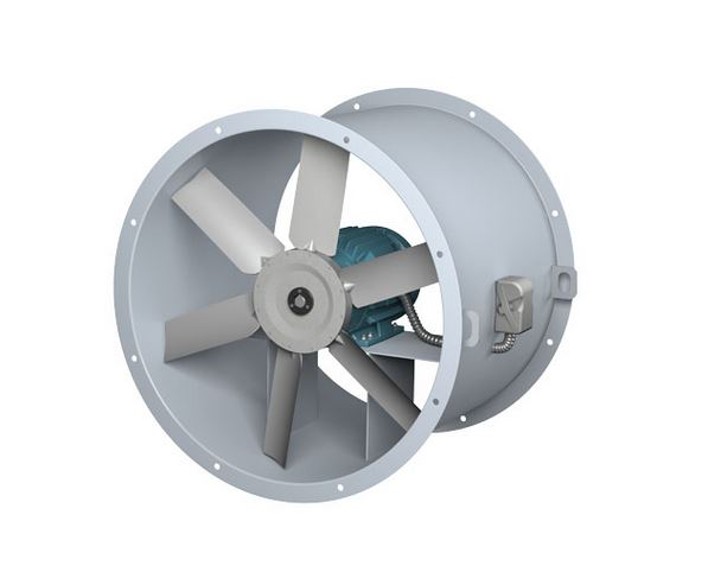
Axial flow fans are widely used in industrial ventilation systems where moving large volumes of air is essential. Two important factors that influence their airflow output are fan diameter and rotational speed. Understanding how these variables work together can help facilities select equipment that delivers the required ventilation performance.
Understanding Axial Fan Diameter
Fan diameter directly influences how much air an axial fan can move. A larger fan has a greater blade sweep area, allowing it to interact with a larger volume of air during each rotation. As a result, increasing the diameter can significantly increase the potential airflow output.
Larger fans can also move the required amount of air at relatively lower rotational speeds in certain applications. This may help reduce noise and mechanical stress while maintaining suitable ventilation performance. However, the fan must still be correctly matched to the system’s pressure requirements.
How Fan Speed Affects Airflow
Rotational speed, typically measured in revolutions per minute (RPM), is another major factor affecting airflow. Increasing fan speed generally increases the volume of air moved by the fan. However, higher speed also affects pressure generation, power consumption, and noise.
Fan performance follows established affinity laws. For the same fan and operating conditions, airflow is approximately proportional to rotational speed. Therefore, increasing speed can increase airflow, but it may also result in significantly higher energy requirements.
For this reason, operating a fan at maximum speed is not always the most efficient approach. Selecting an appropriate operating speed based on actual ventilation requirements can provide a better balance between airflow and energy use.
Balancing Diameter and Speed
Diameter and speed should be considered together rather than independently. A larger fan operating at a lower speed may achieve the required airflow while offering advantages in noise and operating efficiency. Conversely, a smaller fan may need to operate at a higher speed to deliver comparable airflow.
The ideal combination depends on factors such as duct resistance, required airflow, available installation space, operating temperature, and pressure requirements. A technical evaluation of the complete ventilation system can help determine the appropriate fan configuration.
Selecting the Right Axial Flow Fan
When comparing options, businesses should review performance curves rather than relying only on diameter or RPM specifications. Performance curves show how airflow changes with static pressure and help determine whether a particular fan can meet the application’s requirements.
For facilities considering a tube axial fan in India, factors such as local operating conditions, installation requirements, maintenance access, and expected duty cycle should also be evaluated.
Experienced axial flow fan manufacturers can provide technical guidance on fan dimensions, motor specifications, blade configurations, and operating speeds. Kumaran Industries can also be considered when evaluating axial fan solutions for industrial ventilation requirements.
Conclusion
Fan diameter and rotational speed play an important role in determining axial fan airflow output. Larger diameters can support greater air movement, while increased speed generally raises airflow but also affects power consumption and noise. Evaluating both factors alongside system resistance and operating requirements helps ensure effective fan selection.
Looking for an axial flow fan suited to your ventilation requirements? Contact Kumaran Industries to discuss your application and identify a suitable airflow solution.
FAQs
1. Does increasing axial fan diameter increase airflow?
Yes. A larger diameter provides greater blade sweep area, allowing the fan to move more air per rotation when other operating conditions remain comparable.
2. How does fan speed affect airflow output?
Increasing rotational speed generally increases airflow. However, it can also raise pressure, energy consumption, noise, and mechanical loading, making appropriate speed selection important.
3. Is a larger axial fan always more efficient?
Not necessarily. Efficiency depends on system resistance, operating point, blade design, motor performance, and application requirements. A larger fan may operate efficiently at lower speeds.
4. What factors should be considered besides fan diameter?
Static pressure, required airflow, rotational speed, duct configuration, motor capacity, installation space, operating temperature, noise levels, and energy consumption should all influence fan selection.
5. Why are fan performance curves important?
Performance curves show the relationship between airflow and pressure, helping users determine whether a fan can deliver the required airflow under actual system operating conditions.


