
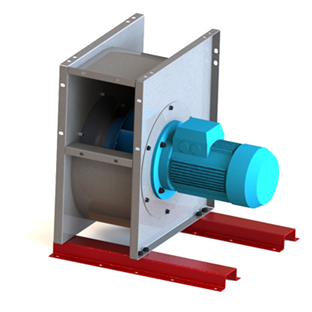
Centrifugal fans are widely used in industrial ventilation, air-handling, and exhaust applications where reliable airflow and pressure are required. While motor performance and fan size are important, blade design also plays a major role in determining how efficiently a fan operates and how much noise it generates.
Understanding Centrifugal Fan Blades
Centrifugal fans use rotating blades to draw air into the fan and redirect it outward through the housing. The shape, angle, width, and curvature of these blades influence how air moves through the system.
Different blade configurations are designed for different operating requirements. Common designs include forward-curved, backward-curved, and radial blades. Each configuration offers a different balance of airflow, pressure generation, efficiency, and acoustic performance.
How Blade Design Affects Efficiency
Blade geometry determines how effectively mechanical energy from the motor is transferred to the moving air. A well-designed blade can reduce unnecessary turbulence and minimize aerodynamic losses, allowing more of the input power to contribute to useful airflow.
Backward-curved blades, for example, are commonly associated with efficient operation because they can provide strong airflow and pressure while limiting excessive power consumption under appropriate operating conditions. Forward-curved blades can deliver high airflow from relatively compact units but may have different power and operating characteristics.
Blade surface quality and manufacturing precision also matter. Uneven surfaces, poor alignment, or damaged blades can disturb airflow and reduce overall fan efficiency. Properly maintained blades help preserve the intended aerodynamic performance.
The Connection Between Blade Design and Noise
Noise is another important consideration when selecting a centrifugal fan. Air turbulence, blade-pass frequency, vibration, and motor operation can all contribute to sound levels.
Blade geometry can influence the amount of turbulence produced as air passes through the fan. Smooth airflow generally reduces unnecessary aerodynamic noise, while poorly matched blade angles or operating conditions can create additional turbulence and sound.
Operating speed is also important. Higher rotational speeds can increase airflow but may produce greater aerodynamic and mechanical noise. Selecting a fan with an appropriate blade configuration and operating point can therefore help balance ventilation performance with acceptable noise levels.
Choosing the Right Fan Configuration
The appropriate blade design depends on the application’s airflow, static pressure, space limitations, operating environment, and efficiency requirements. Businesses should review performance curves and technical specifications instead of choosing a fan based solely on airflow capacity.
Working with a centrifugal blower manufacturer in India can help facilities assess blade configurations according to their specific operating conditions. It is also useful to consider maintenance requirements, motor efficiency, vibration control, and expected operating hours.
Experienced centrifugal fan manufacturers in India can provide different blade designs and configurations for industrial applications. Kumaran Industries can be considered when evaluating centrifugal fan solutions where airflow performance, efficiency, and noise management are important factors.
Conclusion
Centrifugal fan blade design has a direct influence on airflow efficiency and acoustic performance. Blade shape, curvature, operating speed, and manufacturing quality all affect how effectively air moves through the system. Selecting the right configuration for the intended operating conditions can help achieve reliable airflow while managing energy consumption and noise.
Looking for a centrifugal fan suited to your application? Contact Kumaran Industries to discuss your airflow, efficiency, and noise requirements and identify an appropriate fan solution.
FAQs
1. How does blade shape affect centrifugal fan efficiency?
Blade shape influences airflow direction, turbulence, pressure generation, and energy transfer. Selecting the appropriate configuration can reduce aerodynamic losses and improve efficiency under specific operating conditions.
2. Which centrifugal fan blades are generally more efficient?
Backward-curved blades are often associated with efficient operation because they can provide required airflow and pressure with comparatively favorable energy characteristics under suitable system conditions.
3. Can centrifugal fan blade design reduce noise?
Yes. Appropriate blade geometry can reduce turbulence and aerodynamic disturbances, helping control noise. However, fan speed, vibration, motor operation, and system design also influence overall sound levels.
4. Does fan speed affect noise levels?
Yes. Increasing rotational speed generally increases airflow but can also increase aerodynamic and mechanical noise. Operating the fan at an appropriate speed helps balance ventilation performance and acoustics.
5. What should be considered when selecting centrifugal fan blades?
Consider required airflow, static pressure, efficiency, noise levels, operating speed, installation space, environmental conditions, maintenance requirements, and the specific blade configuration suited to the application.


