
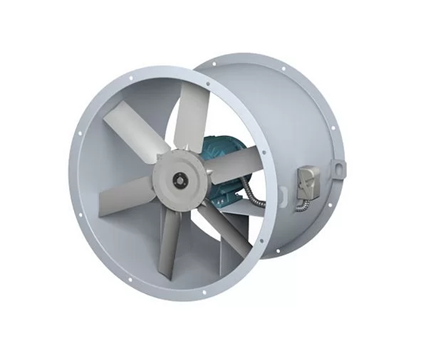
In any industrial setting—from vast manufacturing floors to high-demand cooling towers—moving large volumes of air efficiently is critical. Axial flow fans are the unsung heroes of these operations, driving air parallel to the shaft around which their blades rotate. While the motor provides the power, the true performance of the fan is dictated entirely by its blade design.
A poorly designed blade wastes electricity and creates deafening industrial noise. Conversely, a precision-engineered blade optimizes airflow, drastically reduces power consumption, and maintains a safer, quieter working environment. Here is exactly how blade design dictates the success of an axial flow fan.
1. The Physics of Blade Pitch (Angle of Attack)
The pitch, or the angle at which the blade meets the air, is the most crucial factor in determining how much air the fan can move (CFM) and the pressure it can generate.
If the pitch is too flat, the fan barely moves any air, regardless of how fast the motor spins. If the pitch is too steep, the blade struggles to cut through the air, creating massive aerodynamic drag. This forces the motor to draw significantly more power and often leads to the motor burning out prematurely. Advanced blade designs carefully calibrate this angle to find the “sweet spot”—maximizing air volume while keeping the electrical load on the motor to an absolute minimum.
2. Aerodynamic Profiling (The Airfoil Shape)
Older, basic industrial fans often used flat, stamped metal blades. These are incredibly inefficient because they essentially slap the air, causing severe turbulence.
Modern, high-efficiency blades are designed like airplane wings, featuring an “airfoil” profile. The curved top surface causes air to move faster over the blade than underneath it, creating a pressure differential that efficiently pulls air through the fan housing. This smooth, aerodynamic slicing drastically reduces drag, meaning the fan can deliver maximum performance using significantly less electricity.
3. Taming Industrial Noise (Blade Count and Shape)
Noise in axial fans is primarily caused by air turbulence and the specific frequency at which the blades cut the air.
The number of blades and their specific shape directly dictate the noise profile. Swept-back or scimitar-shaped blades are engineered to cut the air gradually rather than all at once, significantly reducing the harsh chopping noise associated with straight blades. Additionally, optimizing the clearance between the blade tip and the fan housing minimizes “tip stall”—a major source of high-frequency noise and vibration that can wear down the fan’s mechanical components over time.
4. Material Selection
The weight of the blade impacts both efficiency and longevity. Leading axial flow fan manufacturers in India have largely moved away from heavy cast iron or thick steel, favouring lightweight, high-strength materials like cast aluminium alloys or fiberglass-reinforced plastics. Lighter blades require less torque to spin, reducing the immediate electrical surge required during start-up and minimizing long-term wear on the motor bearings.
Partner with Kumaran Industries
Achieving optimal industrial ventilation requires more than just buying a fan; it requires investing in precision aerodynamic engineering. As a leading industrial fan supplier and premier industrial fans and blower’s manufacturer, Kumaran Industries specializes in designing axial flow fans that deliver uncompromising performance. Our custom-engineered blade profiles maximize airflow, minimize electrical draw, and significantly reduce operational noise, ensuring your facility runs efficiently and safely.
Stop letting inefficient ventilation drain your operational budget. Contact Kumaran Industries today to upgrade to precision-engineered axial flow fans designed for maximum efficiency!


