
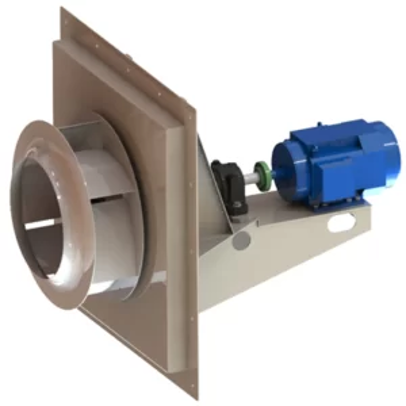
Industrial plug fans are widely used in ventilation, air-handling, process cooling, and other applications where dependable airflow and energy efficiency are essential. Their performance depends on several factors, including aerodynamic design, manufacturing precision, motor selection, and testing. Reliable manufacturers follow systematic practices to ensure fans deliver consistent performance under demanding operating conditions.
1. Optimizing Fan Design
Fan design has a direct impact on airflow, pressure generation, noise, and energy consumption. Manufacturers evaluate factors such as impeller geometry, blade configuration, diameter, rotation speed, and airflow characteristics to develop efficient fan designs.
Proper aerodynamic design helps reduce unnecessary turbulence and energy losses, allowing the fan to deliver the required airflow with efficient power consumption.
2. Using Quality Materials
Material selection is another important factor affecting durability and performance. Depending on the application, manufacturers may use materials selected for strength, corrosion resistance, temperature tolerance, and long-term reliability.
High-quality components can help the fan withstand continuous operation and demanding industrial conditions while reducing the likelihood of premature component failure.
3. Precision Manufacturing
Manufacturing accuracy plays an important role in plug fan performance. Impellers and other rotating components need to be manufactured according to precise specifications. Proper alignment and dimensional accuracy help maintain stable operation and minimize vibration.
Balancing rotating components is particularly important because an improperly balanced impeller can increase vibration, noise, bearing wear, and maintenance requirements.
4. Selecting Suitable Motors
Motor selection should match the fan’s airflow, pressure, speed, and operating requirements. Manufacturers consider factors such as motor power, efficiency, duty cycle, and operating environment when configuring a fan.
Using an appropriately sized motor helps prevent unnecessary energy consumption while ensuring the fan can operate reliably under its intended load.
5. Testing Performance
Reputable industrial plug fan manufacturers use testing and inspection procedures to verify fan performance before delivery. Testing may evaluate airflow, pressure, speed, power consumption, vibration, and noise levels.
These checks help identify manufacturing or assembly issues and provide greater confidence that the fan will perform according to its intended specifications.
6. Providing Application-Based Solutions
Every industrial facility has different ventilation and air-handling requirements. Manufacturers therefore consider factors such as system resistance, installation configuration, temperature, airflow volume, and operating conditions when recommending a plug fan.
An experienced industrial fan supplier can also help customers select suitable configurations and provide technical guidance for installation and operation.
Kumaran Industries can be evaluated based on its approach to industrial fan solutions, product requirements, and application-specific performance needs.
Conclusion
Industrial plug fan performance and efficiency depend on careful design, quality materials, precision manufacturing, suitable motor selection, and thorough testing. Choosing a manufacturer that considers these factors can help businesses achieve reliable airflow, efficient operation, and longer equipment service life.
Looking for a suitable industrial plug fan solution? Contact Kumaran Industries today to discuss your airflow requirements and find the right configuration for your application.
FAQs
1. What affects the efficiency of an industrial plug fan?
Efficiency depends on impeller design, motor selection, operating speed, airflow resistance, system configuration, component quality, and regular maintenance. Correct sizing also helps minimize unnecessary energy consumption.
2. Why is impeller balancing important for plug fans?
Proper impeller balancing reduces vibration and mechanical stress during operation. It also supports smoother performance, protects bearings and other components, reduces noise, and can improve overall equipment reliability.
3. How do manufacturers test industrial plug fans?
Manufacturers may evaluate airflow, pressure, power consumption, speed, vibration, and noise during testing. These checks help confirm that the fan meets specified performance and operational requirements.
4. Can plug fans be customized for different applications?
Yes, plug fans can often be configured according to airflow, pressure, temperature, installation space, motor requirements, materials, and other application-specific conditions to achieve suitable performance.
5. How does motor selection affect fan performance?
An appropriately selected motor provides the required power without unnecessary energy consumption. Correct motor sizing also supports reliable operation, efficiency, thermal performance, and consistent airflow under expected operating conditions.


